We work Nampa out of the shop at 1005 Commercial Way in Caldwell. American Rooter & Drain has served the greater Treasure Valley since 1945. Call (208) 366-5771 and we'll put a camera in the line before anyone quotes you a number.
What is Orangeburg pipe, and why is so much of it still under Nampa?
Orangeburg is layered wood pulp and pitch, pressed into pipe and coated in a bituminous sealant — not clay, not iron, a fiber composite that briefly filled a real gap during and after the Second World War, when cast iron was scarce and the country still needed sewer pipe going into new construction. It was cheap, light, and easy to cut with a handsaw, which made it popular with builders working fast, and it was manufactured and installed widely from roughly 1945 into the 1970s before the industry moved on to PVC.
Nampa's older downtown core grew up during almost exactly that window, alongside the canal-fed agricultural economy that built out much of the city's original commercial and residential blocks. That timing is the whole reason Orangeburg shows up here as often as it does — it was simply what a builder reached for on a Nampa lot going up in 1955, the same way clay was the older, more established choice a decade or two earlier. A camera is the only way to know which material a specific address actually got, because both were common enough in the same neighborhoods across the same twenty-five-year window.
How does a fiber pipe actually fail, and how is that different from clay?
Clay fails at the joint — a rigid seal that eventually cracks or separates as the ground around it moves. Orangeburg fails along the whole pipe wall instead. The bituminous coating that was supposed to keep it rigid breaks down over decades of contact with wet soil and wastewater, and once that happens the fiber layers underneath start to absorb moisture and lose their shape under the ordinary weight of the backfill sitting on top of them. The result is a pipe that goes oval rather than round, squeezed narrower from top to bottom the way a wet cardboard tube collapses under a steady load. Advanced enough, the layers separate entirely — delamination — and pieces of the pipe wall itself start coming apart and traveling downstream with everything else in the line.
A cable through an ovaled Orangeburg line is a genuinely different proposition than a cable through a clay line with a root mat in it. There's real risk of the auger head catching a soft, delaminating wall and doing damage to a pipe that was already failing on its own, which is one more reason the camera goes first here rather than reaching for a snake on a first call to an older Nampa address.
Does the ground near Nampa's canal system make any of this happen faster?
Yes, and it's worth understanding why rather than taking it as a given. The canal network that fed Nampa's agricultural growth keeps the soil near it wetter for more of the year than ground further from any ditch, and both clay joints and Orangeburg pipe walls respond to that extra, sustained moisture in the same general direction — faster. A clay joint sitting in consistently damp soil separates sooner than one in ground that dries out between waterings. An Orangeburg wall exposed to more contact time with wet ground breaks down its bituminous coating faster than one in drier soil elsewhere in town. Neither failure needs the canal to happen eventually, but proximity to one shortens the timeline on a lateral that was always going to fail on its own schedule.
Is it really the same backup, or did the last cleaning only look like it worked?
Ask this before authorizing another cable pass: did the last cleaning actually hold, or did it just buy a few quiet months? Those are different outcomes, and homeowners often can't tell them apart from the fixture alone. An Orangeburg wall that's already going oval, or a clay joint that's already separated, doesn't care how many times a cable runs through it — the channel reopens a little narrower each time, because the underlying shape of the pipe never changed, only the debris sitting inside it did.
A camera answers the question directly: a pipe that's still round and intact just needs drain cleaning in Nampa; a pipe that's lost its shape needs to be replaced, and no cleaning schedule changes that.
What does an older sidewalk or driveway obligate you to once the line has to come out?
Nampa's downtown-adjacent blocks carry decades of concrete sidewalk and driveway work laid down long after the original sewer laterals went in, much of it under standards the original builders never had to meet. Cut a continuous trench across that ground and you're not just disturbing dirt — you're cutting concrete that then has to be restored to current standard, which on an older block can mean more than just patching the section you opened. Pipe bursting sidesteps most of that obligation by keeping the disturbance to two contained access pits rather than a trench the length of the property, which on a lot with an established driveway or sidewalk crossing the pipe's path is often the difference between a weekend of restoration and a much longer one.
How does the pipe actually get replaced, from fractured clay to fused HDPE?
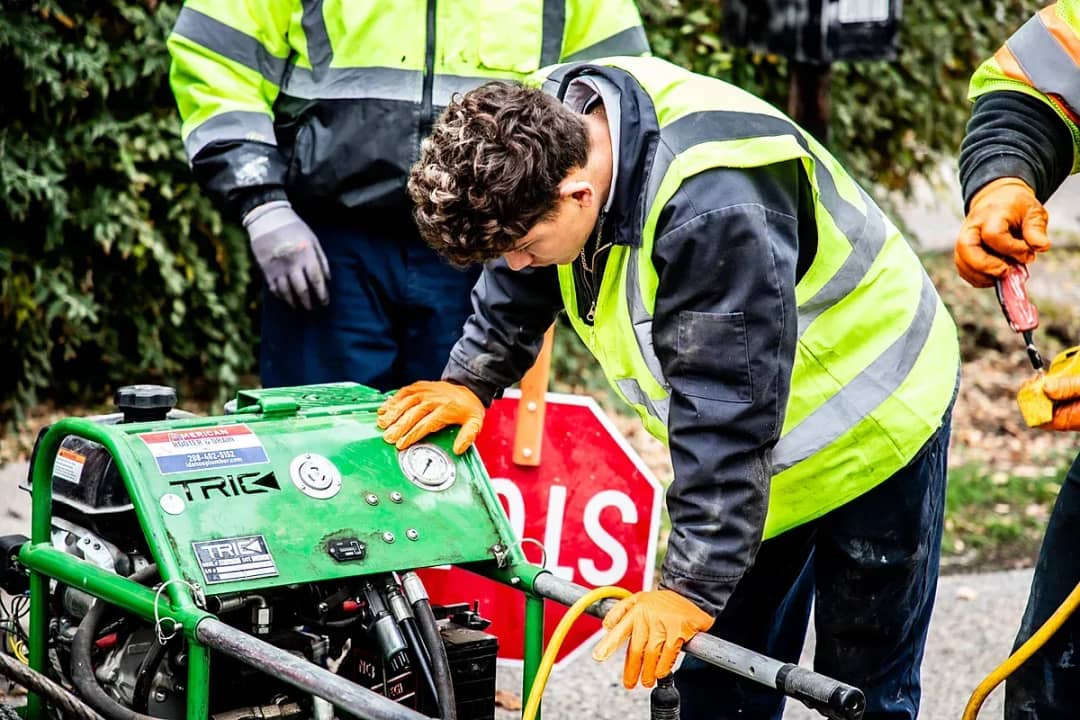
Nothing gets excavated along the pipe's actual path — that's the part people find hardest to picture until they've watched it happen. A steel expander travels the full length of the old clay or Orangeburg line, towed by a winch working from the second pit, and it doesn't clear a path so much as push the old pipe's material sideways into the soil it's already sitting in. Trailing the expander is the new pipe: HDPE, fused into a single run with no seams anywhere along its length, so there's no fiber wall left to eventually collapse and no mortared joint for canal-side moisture to reopen years later. The crew reconnects both ends once the pull is done — house side first, then the main — and a camera pass through the finished line is the last step before the pits get closed and any surface work gets restored.
What if the camera shows a sound pipe that's just coated?
A pipe that's structurally sound but coated — years of grease or scale built up on the wall, common in a building that's changed kitchens or tenants more than once — doesn't need to be replaced, and we're not going to sell you a job it doesn't need. Hydro jetting in Nampa restores the working diameter on a sound pipe without touching a wall that hasn't failed; bursting a pipe that only needed cleaning would cost you more for a result jetting already gets.
When isn't bursting the fix in Nampa?
A pipe that's collapsed rather than just narrowed can leave too little of a path for an expander to travel through safely. A sharp bend built into the original layout — routed around a foundation or an old utility line that predates current mapping — can be tighter than a bursting head can pull through without risking the new pipe's alignment. And a lateral shallow enough to sit close under a slab or heavy downtown paving doesn't give the old pipe room to fracture outward without pushing that movement straight up into what's above it. When one of those shows up on camera, we'll walk you through trenchless sewer repair in Nampa as the alternative, and a short excavation confined to the problem section is always the fallback if no trenchless method fits the specific spot.
What does a Nampa visit look like, start to finish?
1. History first — when it started, what's been tried, which fixtures are affected.
2. Camera down the line — identifying whether the pipe is clay or Orangeburg, how far the failure runs, and whether it's sound enough to work on. Booked by itself, that same look is a sewer camera inspection in Nampa.
3. A flat price in writing, based on what the camera found, before anyone digs.
4. Access pits opened at the two points that keep the pull short while staying clear of existing concrete wherever the layout allows it.
5. The pull itself — fused HDPE following the expander as the old pipe fractures outward.
6. Reconnection at both ends, then a final camera pass so you see the finished line.
7. Backfill and surface restoration at the two pits only — not the length of the property.
How do Nampa's specific conditions affect what you pay?
There's no flat number, because the real cost drivers vary block to block: how deep the original line was laid, how far it runs to the main, how many access pits the path needs, whether the pipe is clay or delaminating Orangeburg, and whether concrete restoration at the pits is part of the job. Canal-adjacent ground that needs extra shoring adds time the way heavy surface concrete does elsewhere in town — different reasons, similar effect on the schedule. Your written number comes from the camera footage and the site walk, not a rate sheet, and it doesn't cost anything to get to that number.
If a fixture in an older Nampa home or building keeps backing up on a shortening schedule, or a section of yard along the pipe's path settles a little more every year, get a camera in before guessing at the fix. See everything we do around Nampa at our Nampa hub, check sewer line backing up if that's the exact symptom, or browse every city we serve on the pipe bursting overview. Call (208) 366-5771 for a free on-site camera inspection.