
We run out of the shop at 1005 Commercial Way in Caldwell and cover Star on a regular schedule. American Rooter & Drain was established in Caldwell, Idaho in 1945 and has served the greater Treasure Valley since 1945. Call (208) 366-5771 and we will get a camera into the line before anyone talks about digging.
What actually goes wrong under an older Star homestead?
The same thing that goes wrong under most farmhouse-era lots in this part of the valley: a bell-and-spigot clay joint, sealed with mortar that was never meant to flex, sitting in ground that has moved under it for fifty or sixty years. Star was a small farm town for most of its history, and the properties that predate its recent growth were built the way every rural Idaho property from that era was — clay laterals, joined the old way, with decades of settled ground around them. That settling is mostly finished by now, which is actually the point: an old homestead joint fails from slow, cumulative movement finally reaching the point where the mortar seal cracks, not from ground that's still actively shifting underneath it.
Does Star's rapid growth create its own plumbing surprises?
Fast growth means an unusual number of Star properties that don't fit neatly into "old homestead" or "new subdivision" at all — an original farmhouse parcel subdivided into several new lots, with a new lateral tied into a decades-old main that was never sized or routed with that density in mind, or a older property that had a partial repair done at some point using whatever pipe was on hand at the time, leaving one property with two materials joined mid-run. None of that shows up from the street. It's exactly the kind of thing a camera catches in the first pass and a homeowner has no way of knowing until it does.
What actually goes wrong under a new Star subdivision home?
Something that sounds like it shouldn't happen to modern pipe, and mostly doesn't — except at the joints. Gasketed PVC doesn't corrode and doesn't admit roots, and on its own it will outlast the house built over it. What it can't fully resist is the ground it was buried in. A new subdivision lot is built on fill soil, graded and compacted during construction, and fill soil keeps settling for years afterward as it finds its final density — sometimes unevenly, if one section was compacted better than the section next to it. A pipe laid across ground that settles unevenly can develop the same kind of low spot an old clay line develops for a totally different reason: not a cracked joint letting soil in, but a joint under the pipe's own gasket getting stressed by differential settling until the two sections it connects sit at slightly different heights.
Is a fifty-year-old clay joint failing the same way a five-year-old PVC line?
Not the same mechanism, but the same result on a camera: a section of pipe that no longer drains itself between uses. That's worth separating clearly, because the fix people expect for "new construction problem" and "old pipe problem" is often different, and here it isn't. Whether the cause is mortar finally giving out after decades or fill soil still settling after five years, the diagnosis and the repair converge on the same answer once the camera confirms what's actually happening below ground.
How does the camera tell an old joint failure apart from new-construction settling?
Mostly by what's around the failure point, not just the failure itself. An old clay joint typically shows visible separation at the joint, sometimes with soil or root hair visible through the gap, and the pipe material on camera is unmistakably clay rather than plastic. A settling-related failure in newer PVC usually shows an intact joint that has simply been pulled out of alignment — the gasket connection often still seals, but the two straight runs on either side of it no longer share the same slope. Reading which one you have tells us whether we're dealing with a material that has genuinely failed or a material that's sound but sitting on ground that moved it out of position.
Same fixture, same low spot — new clog or old one refilling?
On either kind of lot, usually the old one refilling. A backup that's truly resolved doesn't return on its own; if a Star line was cabled and the same fixture backs up again within a season, the honest explanation is that the pipe's own shape — whether from a decades-old cracked joint or a few-years-old settled joint — is putting the material back each time, not that a new clog appeared on its own.
How does pipe bursting answer both problems with one method?
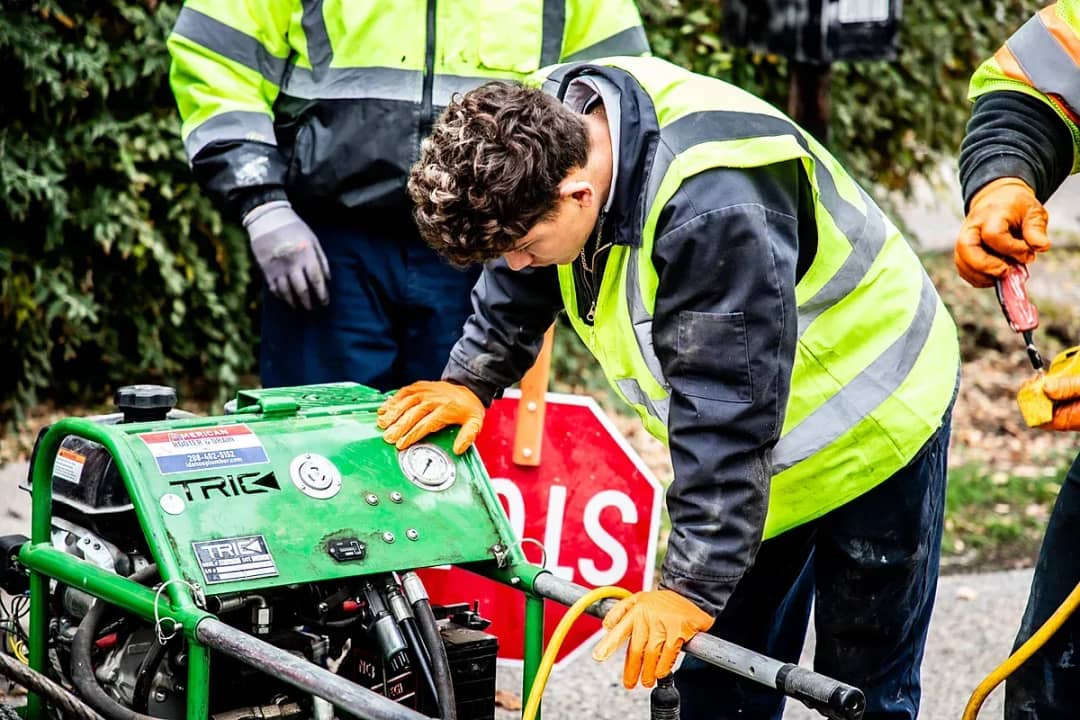
Because bursting replaces the pipe rather than repairing the specific joint that failed, it works the same way regardless of which cause put the low spot there. A steel expander head is winched through the existing line from an entry pit to an exit pit, fracturing an old clay pipe outward or clearing the path of a failed PVC section as it travels, and a new length of HDPE — fused into one continuous run with no joints anywhere along it — is pulled in directly behind. On an old homestead lot, that also means no trench through decades of established landscaping. On a new subdivision lot, it means not reopening a yard that was just finished being graded and sodded.
When is bursting not the right call, on an old lot or a new one?
A few situations point elsewhere regardless of the lot's age. On an old homestead, a joint gap wide enough that the pipe ends have dropped out of alignment entirely can be past what an expander should be asked to widen in one pass, and a sharp bend routed around a mature tree that predates the lateral itself can be tighter than a bursting head should travel through. On a new subdivision lot, if the settling is still actively in progress rather than substantially finished, replacing the pipe now can mean doing the same repair again in a few years once the ground underneath finishes moving — in that case, a targeted regrade or a wait-and-monitor approach after a camera baseline can be the more honest answer. Either way, if the camera shows debris or roots in an otherwise sound pipe rather than a real structural failure, hydro jetting in Star or a standard drain cleaning in Star is the right, cheaper call instead.
What about properties on septic along Star's rural edges?
Star's outer edges still carry a fair number of properties on private septic rather than city sewer, and the joint-separation and settling problems described above show up on the house-to-tank lateral for the same reasons — an older homestead's clay joint or a newer property's still-settling fill soil doesn't care what's on the other end of the pipe. Bursting the house-to-tank run works the same way regardless. See septic services in Star if the tank side of the system is the part you're actually trying to sort out.
What happens once the pull actually starts, in order?
1. What's been happening. How old the property and the line actually are, and whether it's been cabled before.
2. Camera down the line. We identify pipe material and read whether the failure is a cracked joint or a settling-related offset — on its own, this is our sewer camera inspection in Star.
3. A flat price in writing, based on what the camera actually found.
4. Entry and exit pits opened, positioned around whatever's worth protecting on that specific lot — mature landscaping on an older property, finished sod on a newer one.
5. The pull — fused HDPE pulled through behind the bursting head, the old or failed pipe fractured outward and left in the soil.
6. Reconnect both ends, then a final camera pass confirming the new line's grade before backfilling.
7. Backfill the two pits, and nothing more.
Which conditions add time once the crew has started?
A couple of things push a job past its planned time here, and they differ by which kind of lot it is. On an old homestead, a joint that's migrated further than the first camera pass could confirm from one end alone sometimes means checking it again from the second pit before the pull length is finalized. On a newer subdivision lot, fill soil that's still noticeably soft at the pit locations can need extra compaction work before backfilling holds the way it should. Neither changes the flat price once it's written — that time is ours to absorb.
What actually determines the price of a Star bursting job?
There is no flat rate, because the variables differ by lot type as much as by lot size: an older homestead's run length and depth versus a newer subdivision's fill-soil condition and how recently it was graded, whether a usable cleanout exists, and how many pits the specific path needs. The number we hand you in writing comes from what the camera shows and what the site walk confirms about that specific lot, and the estimate itself is free.
If a Star property — old or new — keeps sending the same fixture into a backup, get the camera in before assuming the age of the house tells you anything about the cause. See everything we do around town at our Star hub, check tree roots in a sewer line if that's the visible symptom on an older lot, or browse every city we serve on the pipe bursting overview. Call (208) 366-5771 for a free on-site inspection.