What snaking does, and what it does not
A cable is a boring tool. It reaches a plug, drills a hole through it or grabs it, and water starts moving again. For a blockage that is a plug, that is exactly the right job: a wad of hair in a trap, a toy or a wipe lodged in a bend, a lump of paper at a joint, food packed into a sink line.
A cable is the wrong tool when the pipe itself is the problem. It does not scrape the full wall of the pipe, and it does not repair anything. Know the three cases where a snake gives you a quick win and a short one:
- Grease-coated lines. The cable punches a channel through the middle of a grease mat. The sink drains for a few weeks, and the mat is still stuck to the pipe wall, ready to close up again. A line like that needs hydro jetting, which scours the wall instead of drilling through the plug.
- Tree roots. A cutting head can clear roots out of a line, but roots enter through a joint or a crack. They grow back into the same opening, and the clog returns. Our page on tree roots in sewer lines explains how that happens and what stops it.
- A broken or sagging pipe. A crushed section, an offset joint or a low spot holding water will snag a cable, and no amount of snaking fixes the pipe. That takes a camera and a repair.
If the cable keeps stopping at the same distance every time, that is the pipe telling you something. Stop snaking and have a look inside it.
The four tools, in plain language
Not every snake is the same, and the difference matters for your pipes.
Hand auger. A coil of cable in a drum, turned by a hand crank. You can buy one at a hardware store. It reaches the first few feet of a sink or tub line and not much farther, which is why a homeowner snake often goes nowhere or only pokes a hole.
Closet auger. A short, rigid shaft with a bend at the end, made to go into a toilet bowl. The bend lets it follow the curve of the toilet trap without scratching the porcelain, and it reaches what a plunger cannot. It is the right tool for a toilet. It is not meant for anything else. A regular cable forced through a toilet can scratch the bowl, and it is a rough way to get through a toilet trap.
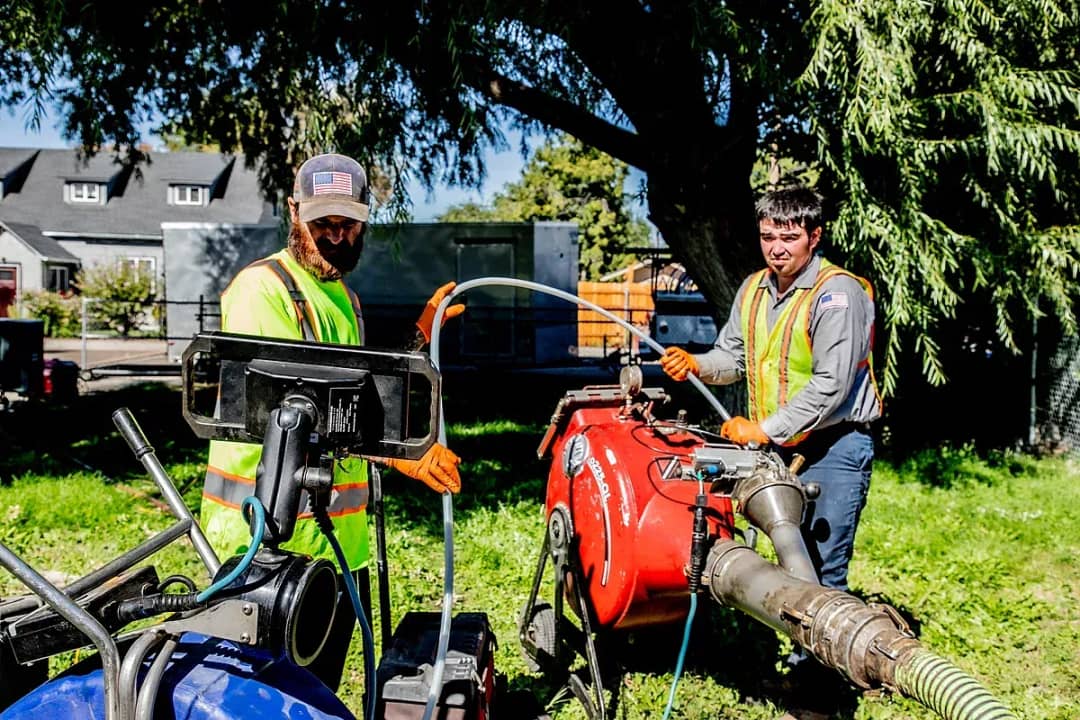
Drum machine. A powered cable stored in a drum, spun by a motor. A technician feeds the cable in while the motor turns it. A small cable, a quarter or five-sixteenths of an inch, is the usual choice for sink, tub, shower and floor drain lines, because the cable and its cutting head are sized to the pipe. Drum machines are what we run on most fixture calls.
Sectional machine. A heavier machine that uses sections of stiff cable joined together, with a larger motor and bigger cutting heads. Sections reach farther and have the muscle to cut through roots and heavy buildup in a larger line. This is what a main sewer line clog calls for, and it is not a machine you want pushing into a thin bathroom sink line.
The takeaway is that the machine and the head are chosen to fit the pipe. Too small and it does not cut. Too big and it can damage a tailpiece, a thin trap or an old fitting.
Why the homeowner snake often does not hold
Most people who call us have already tried. A few things go wrong with the hand auger and the drain-store snake.
It reaches the first plug and stops. The cable pokes a hole in the soft part of the clog, water drains, and it feels fixed. The rest of the blockage, the part stuck to the pipe wall, is still there.
It is not strong enough to cut. A light cable bends instead of cutting. It pushes soft buildup farther down the line, where it settles again in a colder, narrower stretch and stops up again, out of reach.
It can hang up and bind. A cable that catches a joint or a bend can twist and kink. Forcing it can leave a mess in the trap or scratch a fixture.
It does not tell you what is wrong. You snake, the water drains, you hope. A clog that comes back is not bad luck. It is a pipe with a reason, and a snake alone never shows you the reason.
If you have snaked the same drain more than once, or the clog has come back within a few weeks or months, skip the next snake. Read our page on clogged drain repair, because that pattern means something in the pipe is causing the clog.
What happens on our visit
1. You call and describe it. Which fixture, how long it has been slow, what you have tried. If you poured a chemical drain opener in, tell us. It changes the protection we bring and we deal with that first.
2. We find where the blockage is. One slow fixture points to its own branch. Several fixtures slowing together, or gurgling, point to the main line.
3. We choose the machine and head to fit the pipe. A drum machine and a small cable for a fixture, a toilet auger for a toilet, a sectional machine for a main line.
4. We run the cable and clear the blockage. We keep working until the line runs freely, not just until the first trickle of water gets through.
5. We confirm it drains, then tell you what we found. If the cable pulled out hair, you will know. If it came back with roots, grease or scale, you will know that too, and we will tell you straight whether a snake is enough or the line wants jetting or a look with a camera.
When a snake does not tell the whole story, we run a sewer camera inspection so you can see inside the pipe on a monitor. That turns a guess into an answer: grease, roots, a break, or a low spot.
Snaking by fixture
The fixture changes the approach, and we have a page for each one:
- Toilets use a closet auger, not a standard cable. See clogged toilet.
- Kitchen and bathroom sinks are cleared through the trap with a small cable. See clogged sink, including why a kitchen sink slows down for months before it stops.
- Showers and tubs are best reached through the overflow plate rather than down the drain. See clogged shower or tub drain.
- Floor drains, laundry lines and the main sewer line get their own approach and a larger machine. See drain cleaning for the full list of what we clear.
When to stop snaking and call us
Call instead of snaking again if any of these are true:
- More than one drain in the house is slow, or one drain gurgles when another fixture runs.
- Water rises in a tub or shower when you flush the toilet or run the washer.
- What comes up is dark or smells like sewage.
- The drain clogs again within weeks or months of being cleared.
- You poured a chemical drain opener and it did not work. Do not add a second product. Mixing openers can react.
What it costs
Clearing a single branch line, one fixture and not a main line clog, is covered by our $59 drain cleaning special. Past that, what moves the price is which fixture is involved, whether there is a cleanout or other way in, whether the line needs a cable or jetting, and whether the trouble sits in the branch or the main. We diagnose first, then hand you a flat price in writing that you approve before anything starts. It is a flat rate and not an hourly meter, and on-site estimates are free.
Where we work
American Rooter & Drain was established in Caldwell, Idaho in 1945 and has worked the greater Treasure Valley since 1945. We snake drains in Boise, Nampa, Caldwell, Meridian, Kuna, Eagle, Star, Middleton, Garden City, Emmett and the rest of the valley, plus Ontario, Nyssa and Vale in Oregon. See what we do in Boise, Nampa, Caldwell and Meridian. Call (208) 366-5771, days, nights, weekends and holidays, and book a technician to snake the drain and show you what is causing it.