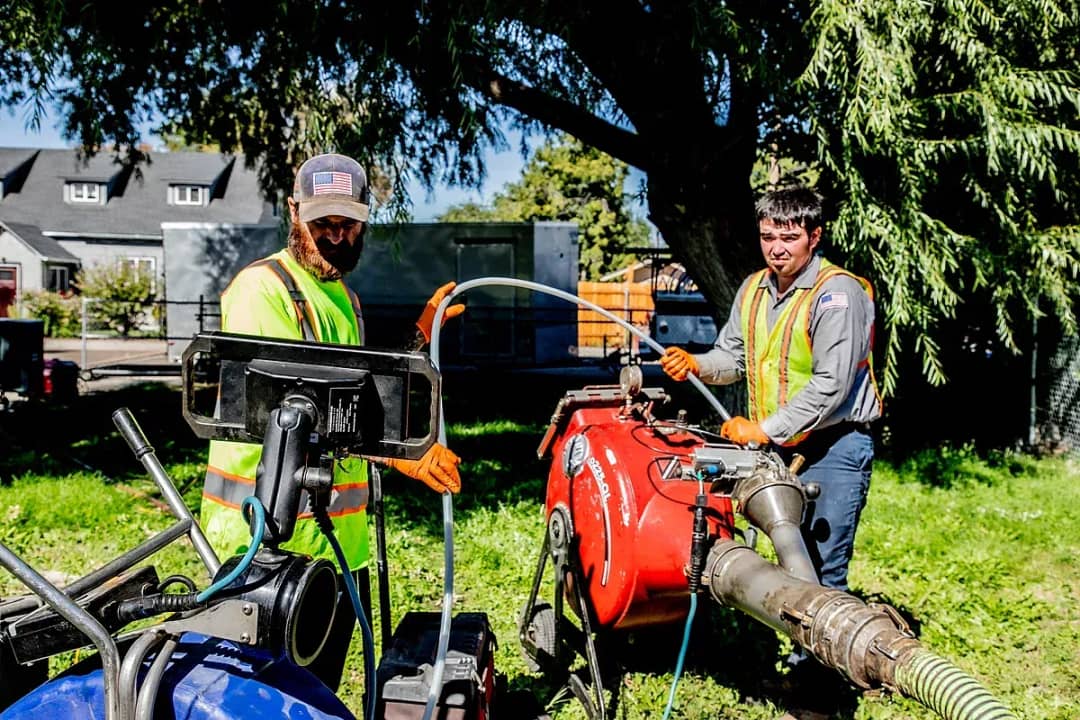
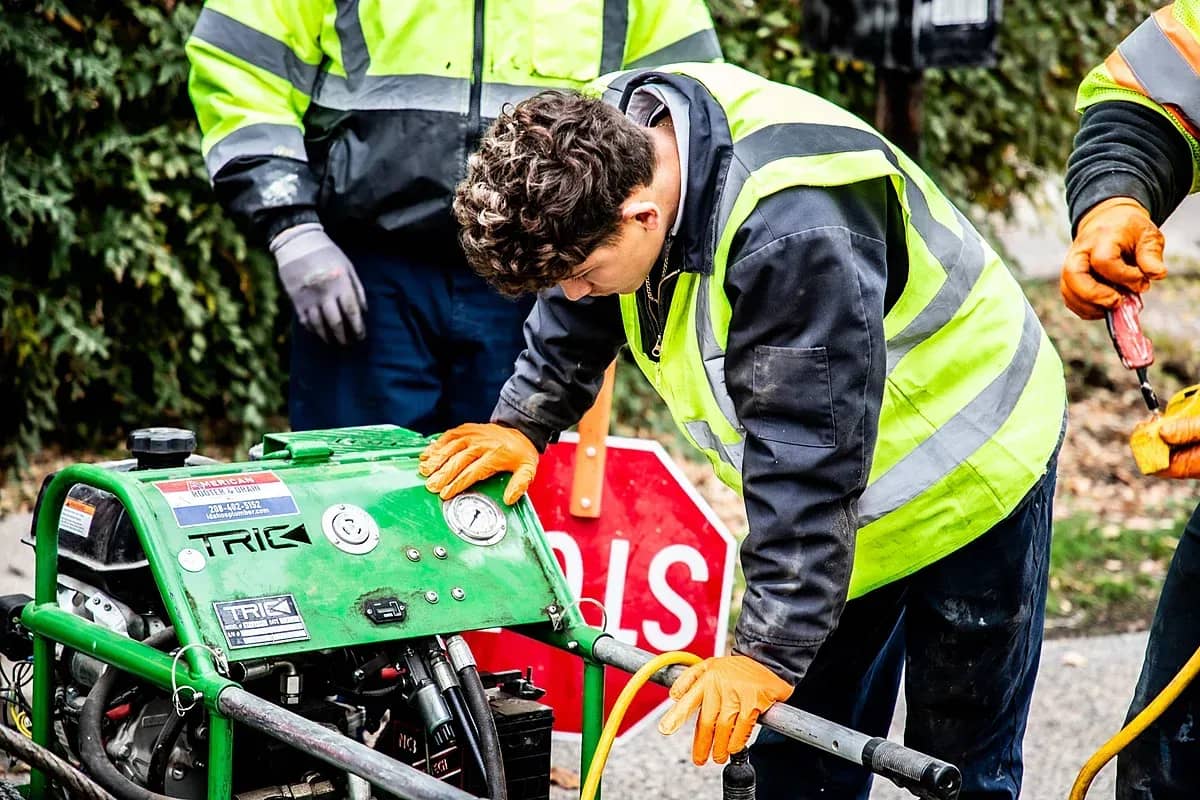
Which of the three Kuna setups is yours?
New subdivision on city sewer
Most Kuna building since the mid-2000s went up on ground that was row crop, pasture or orchard within living memory. Supply is PEX, drainage is PVC or ABS, and the lateral is a straight glued run out to a main that is frequently newer than the house. None of that pipe is corroding. What it does instead is move.
Farm ground that has been leveled, ripped and flood-irrigated for eighty years does not behave like undisturbed soil once a trench is cut through it. Backfill that got pushed in and driven over in July instead of compacted in lifts keeps settling for the next several winters, and the pipe settles with it. The result is a belly: a low spot that holds water and grit in a run with no crack, no root and no visible damage anywhere. A belly does not smell. It does not back up the first year. It does not show on a general home inspection. It shows on a camera, as standing water the lens drives down into and comes back out of on the far side, and the counter on the push cable tells us how far out from the house it sits.
The other new-construction find is somebody's mess. Thinset, grout, drywall mud, a chunk of foam board, a rag left in an open pipe during framing, all of it set up hard in the lateral and narrowing it from the day the house was finished. If a nearly new Kuna home has drained slow since move-in and clearing at the fixture never fixes it for long, that is the first thing we go looking for.
Acreage still on septic
South and east of town, out Swan Falls Road and Kuna-Mora, and on the ground running toward Indian Creek, plenty of property still goes to its own tank and drainfield. Some of those systems are older than the current owner's paperwork on them. A camera earns its keep differently out there. We inspect the house-to-tank run, which behaves like any other sewer line and fails like one, and we can see what is entering and leaving the tank.
What a camera cannot do is tell you a drainfield is healthy from the inside. Drainfield laterals are perforated and bedded in rock, and a sewer camera is the wrong instrument for them. Anyone who tells you different is selling you something. If the tank is due anyway, we pump it, and that's $395 flat for a 1,000-gallon tank. Having the tank down puts eyes on the inlet and outlet baffles while we are already there, which is where a surprising share of slow-drain complaints on Kuna acreage actually end.
The transition properties
Then there is the in-between group, and it is the one we get called on most in this town: a place where city sewer reached the street, the house was tied in, and the old tank was abandoned. Done properly, the lateral was cut and rerouted to the new tap, the tank was pumped and then crushed or filled, and the abandoned branch was capped. Done in a hurry, you inherit a line teed in at an odd angle, a dead branch still running out to a tank nobody dealt with, a cleanout buried under new sod, or a stretch of the original clay tile or cast iron left in service between the house and the new connection because pulling it was harder than leaving it.
A camera run from the house all the way to the main is the only way to find out which version of that job you bought. It is also how we find the abandoned branch that is venting into a crawlspace, which is the usual culprit behind a sewer smell in the house on a converted property.
Buying in Kuna? Put the sewer in your inspection window
A lot of Kuna stock changes hands, and the sewer line is the most expensive single item on a residential property that a standard home inspection does not touch. An inspector will run water, watch it go down, and write "functional." That tells you nothing about the eighty feet between the house and the street.
Scope it while you still have leverage. One visit puts on record the material and rough age of the line, whether it is one continuous run or a splice of two different eras, whether roots have found the joints yet, whether there is a belly and how much water it holds, whether the property was ever converted off septic and how cleanly that was done, and where the cleanout actually is, because plenty of Kuna houses have one and nobody currently living there can find it.
The footage is yours to keep. Buyers have used it to reprice a deal. Sellers have used it to shut down a speculative repair demand before it got started. Either way the conversation is about video instead of opinion.
What the camera shows, and what happens next
We record the run and then play it back with you before we leave the driveway, not as a summary emailed three days later. Standing water, where it starts and where it ends. Root hair at a joint versus a mass that has taken the pipe. An offset where two sections have shifted apart. A crushed section. A tap cut in badly. Grease and scale, which in newer PVC is almost always a habit problem rather than a pipe problem.
Then the recommendation matches what is on the screen. A single cracked or crushed section gets a spot repair and nothing else gets touched. An old clay or cast iron remnant left in service from the septic days gets replaced, because it will fail regardless of how good the rest of the run looks. Construction debris gets cut out and flushed through. A belly does not get lined or jetted into behaving; it has to be opened, re-bedded and re-graded to the correct fall, and anybody offering to line over it is treating a symptom. And if the run is sound, we say so and you spend nothing further.
If the reason you are reading this is a sewer line backing up, backups that keep returning after they have been cleared, or a toilet that will not clear no matter what you do, the camera is how we tell you whether you had a one-time clog or a pipe problem that will keep buying us both work.
What it costs
We do not publish a number for a repair nobody has looked at, and you should be wary of anyone who does. What moves the price on a Kuna job is short and knowable: how far the run is from the cleanout to the main, whether there is a usable access point or one has to be created, whether the line has to be cleared before the lens can see past anything, how deep the pipe sits, and what is on top of it. Depth matters more here than people expect, because plenty of newer Kuna laterals sit lower than the yard suggests where street grade was cut for the subdivision.
So we come out and look. The on-site estimate is free, the work is priced flat and agreed before it starts, and if the line has to be cleared before the camera can pass we clear it first and then film it, so you see the pipe you just paid to clean.
Get the line looked at
American Rooter & Drain has served the greater Treasure Valley since 1945, out of the shop at 1005 Commercial Way in Caldwell, Idaho. Call (208) 366-5771 and we will put a camera in your line and show you exactly what is down there.
See everything we handle in Kuna, or read how sewer camera inspection works across the rest of the valley.