We run these calls out of the shop at 1005 Commercial Way in Caldwell. American Rooter & Drain has served the greater Treasure Valley since 1945. Call (208) 366-5771 and we'll get a camera into the line before anyone talks about a shovel.
What is actually failing under an older Boise lot?
Clay tile and Orangeburg are both common on North End, East End, and Depot Bench lots, and they do not fail the same way, which is worth knowing before you assume you know what the camera will find. Clay tile comes in short sections joined bell-to-spigot, sealed with mortar or a packed oakum-and-cement compound that was built to hold a fixed position, not to flex. Decades of ground movement crack that seal, and the joint — not the pipe wall — is almost always where a clay lateral actually fails.
Orangeburg fails differently, and it's a harder failure to picture until you've seen it on a monitor. It's a laminated fiber tube, and sustained soil load plus decades of groundwater exposure lets it lose rigidity from the inside out. Instead of cracking, it ovals — the round cross-section slowly flattens into something closer to an egg — and it delaminates, meaning the layered fiber wall starts separating and curling inward along the pipe rather than staying fused into one shell. A camera run through a failing Orangeburg line often shows no single break point at all, just a bore that keeps closing in on itself for twenty or thirty feet. That is a fundamentally different finding than one offset joint, and it changes what a fix even means, since there is no single spot to patch.
Why do the neighborhood's own trees make this worse?
The silver maples and elms lining these streets were planted when the lots were platted, and they are now sixty, seventy, sometimes closer to a hundred years old — bigger, thirstier, and more root-aggressive than whoever laid the original sewer main imagined. A root does not create the opening in a failed clay joint or a delaminating Orangeburg seam. It finds one that already exists, drawn in by the moisture and nutrients leaking out of it, and then it thickens inside that gap year after year until the root itself is holding the joint open as much as the original failure did. That is why cutting roots out of the same spot on the same line, visit after visit, stops being a cleaning problem after the second or third time. The roots keep winning because the opening they're using never closed. If that pattern is what's going on at your place, tree roots in a sewer line is worth reading before booking another cable pass.
Does the season change when an older Boise line actually gives out?
Ground movement isn't constant through the year. Frost depth in the valley reaches down far enough most winters to put real pressure on a shallow lateral, and a joint that's already thinned by decades of root pressure or delamination is the one that finally gives when the ground freezes and heaves in January or thaws and settles again in March. That's part of why these calls cluster in late winter and early spring — not because anything changed about the pipe overnight, but because the freeze-thaw cycle finished a job that root intrusion and decades of ground movement had already started.
Is this the same backup coming back, or a new one?
Worth separating, because the two have different fixes. An obstruction that's genuinely removed stays removed — if a line was cabled clean and it's running slow again at the same fixture within a couple of months, the pipe put the problem back, not something new growing overnight. What the camera is actually reading at that point is whether the material sitting at the stoppage is loose debris inside an otherwise round, intact pipe, or whether the pipe itself has ovaled, delaminated, or opened at a joint. The first is a drain cleaning in Boise call, straightforward and inexpensive. The second means another cable pass buys you a few more months at best, on a channel that started this round already narrower than it was the round before.
What does the city's sidewalk standard have to do with my sewer line?
A lot of these older laterals run under or alongside a public sidewalk panel, a driveway apron, or a parking strip that the city treats as its own right-of-way even though it sits in front of your house. Cutting a trench through that ground isn't just yours to backfill and walk away from — the city has its own standard for how a broken sidewalk panel or driveway apron gets restored, down to thickness and jointing, and it typically gets inspected before it's accepted. None of that is about your sewer line; it's concrete matching a public standard, and it adds a step and a wait that has nothing to do with the actual repair. Two access pits set back off that sidewalk line, on ground that's entirely yours to open and close on your own schedule, sidestep that requirement most of the time. That alone is often the deciding factor for an older Boise lot.
How does pipe bursting actually replace the line?
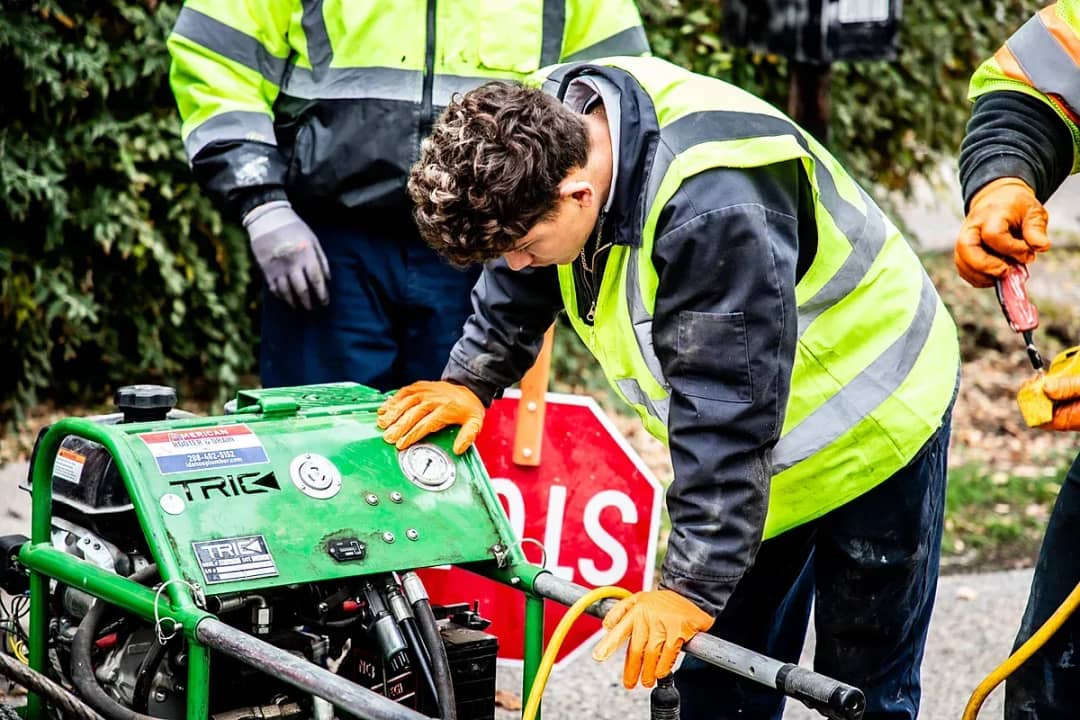
The mechanics are straightforward even though nothing about the result looks dramatic above ground. A bursting head — a coned steel expander — gets winched through the old clay or Orangeburg pipe on a cable run between the two access pits. As it travels, it fractures the old pipe outward into the surrounding soil; nobody digs the old pipe out, it gets broken apart and left where it is. A new length of HDPE pipe, heat-fused into one continuous, jointless run before it ever goes in the ground, trails directly behind the bursting head and takes the old pipe's place as it goes. Once the pull is finished, the crew reinstates the connection at each end — the house trap side and the city main side — and runs the camera through the new line one more time before anything gets backfilled.
When is bursting the wrong tool for an older Boise line?
A few situations point somewhere else. A joint that's offset so far it's closed most of the bore can be past what an expander safely widens in a single pull. A lateral running just a foot or so under a sidewalk panel or driveway, with barely any cover, can be a risk for the ground heave bursting causes as the old pipe fractures — in that case a shorter pit spacing, or a different trenchless sewer repair in Boise method entirely, is the safer call. And if the camera shows a sound pipe that's just coated or root-choked without a structural failure behind it, bursting is simply the wrong purchase — hydro jetting in Boise or a standard drain cleaning in Boise is the honest, cheaper answer, and we'll tell you that with the footage still on the screen.
What happens once the crew is on site, in order?
1. History first — when the backups started, whether the line's been cabled before, which fixtures are affected.
2. Camera down the line — reading pipe material, locating the failure, and mapping exactly how far it runs. On its own, that's our sewer camera inspection in Boise.
3. A flat price in writing, based on what the camera found, before anyone breaks ground.
4. Two access pits opened, set to avoid the sidewalk, the driveway, and anything on the lot worth protecting.
5. The pull — HDPE fused and pulled through behind the bursting head, old pipe fractured outward and left in the soil.
6. Reconnection at both ends, then a final camera pass so you see the result instead of taking our word for it.
What if there's no accessible cleanout on an older lot?
A lot of homes from this era predate the modern two-way cleanout at the property line entirely, especially inside the North End's oldest blocks. If the camera can't find a usable access point close to the foundation, establishing one is its own small job, done before the bursting quote is finalized rather than discovered as a surprise mid-project. It's a real add, and we'll say so up front rather than let it become an unpleasant line item after the pits are already open.
What gets restored after the pits close, and what doesn't?
Sod, mulch, and disturbed topsoil at the two pits get put back close to how they were, and any sidewalk or driveway section that had to be cut gets restored to the city's own standard. What doesn't come back on the same timeline is anything mature that had to be removed to get a pit in a workable spot — a shrub or a section of an old flower bed planted decades ago doesn't regrow on a lawn patch's schedule. We'll walk the lot with you before digging starts and flag anything in that category, so it's a decision you make, not one we make for you.
What actually moves the price on an older Boise lot?
There's no flat rate for this, because the honest cost drivers vary lot to lot: how deep the line was originally laid, how far it runs from the house to the main, how many pits the path needs, whether a sidewalk or driveway crossing adds a restoration step, and what the camera actually finds — clay, Orangeburg, or a section that's already been spliced with something else by a previous owner's repair. We price the job from the camera and a site walk, hand you one number in writing, and the on-site estimate that gets you there is free. That number holds once it's written — if the job runs long for a reason like deeper fill than expected or a tie-in that needs more work to reach cleanly, that time is ours to absorb, not an added charge. The only thing that changes the price is scope you separately approve.
If a North End, East End, or Depot Bench line has backed up more than once at the same fixture, or a strip of lawn along its path stays wet longer than the rest after watering, get the camera in before guessing at a fix. See everything we do around Boise at our Boise hub, or browse every city we serve on the pipe bursting overview. Call (208) 366-5771 for a free on-site camera inspection.